
Most fleet managers assume any good mechanic can handle their vehicles. That assumption costs money. A dedicated fleet mechanic focuses solely on an organization's vehicle fleet, keeping vehicles roadworthy and minimizing downtime, which is a fundamentally different job than fixing whoever walks through the door. If you manage vehicles in Centennial or Parker, Colorado, understanding this distinction is one of the smartest operational moves you can make. This article breaks down exactly what dedicated fleet mechanics do, how they differ from general mechanics, and why that difference matters to your bottom line.
Table of Contents
- Understanding a dedicated fleet mechanic
- Core responsibilities and processes
- Fleet mechanic vs general mechanic: Key differences
- Benefits to fleet managers and owners
- Why most fleet managers underestimate their mechanic's impact
- Reliable fleet maintenance solutions in Centennial and Parker
- Frequently asked questions
Key Takeaways
| Point | Details |
|---|---|
| Specialized preventive care | Dedicated fleet mechanics provide preventive maintenance tailored to your fleet, reducing breakdowns. |
| Enhanced compliance support | Keeping detailed maintenance logs helps ensure regulatory compliance and avoid costly penalties. |
| Minimized downtime | Fleet mechanics improve vehicle uptime with faster diagnostics and repair scheduling. |
| Strategic cost control | Through routine checks and early detection, dedicated mechanics help lower total vehicle ownership costs. |
Understanding a dedicated fleet mechanic
A dedicated fleet mechanic is not just a regular technician who happens to work on multiple vehicles. The role is built around one mission: keeping a specific organization's fleet running efficiently, safely, and in compliance with all applicable regulations. Every task, every inspection, and every repair is filtered through that single lens.
General mechanics work reactively. A customer pulls in with a problem, the mechanic diagnoses it, fixes it, and moves on to the next customer. Fleet mechanics work proactively. They know the full history of every vehicle in the fleet, they track maintenance intervals, and they catch problems before those problems become breakdowns on the road.
Job descriptions for fleet technicians emphasize maintaining specific fleet vehicles, troubleshooting, record-keeping, and compliance. That last word, compliance, is critical. Fleet vehicles often operate under Department of Transportation (DOT) rules, state inspection requirements, and commercial vehicle regulations. A dedicated fleet mechanic understands those rules and builds them into the maintenance schedule.
"A fleet mechanic's value is not measured by how fast they fix a broken vehicle. It's measured by how rarely vehicles break down in the first place."
Here is a quick comparison to frame the difference clearly:
| Feature | Dedicated fleet mechanic | General mechanic |
|---|---|---|
| Vehicle focus | Single organization's fleet | Any vehicle, any customer |
| Maintenance approach | Preventive and scheduled | Reactive and on-demand |
| Record-keeping | Detailed fleet-wide logs | Per-vehicle repair orders |
| Compliance knowledge | DOT, state, commercial regs | General safety standards |
| Cost control | Proactive cost management | Per-repair billing |
| Relationship | Long-term operational partner | Transactional service provider |
When you work with our Centennial fleet services, you get a team that functions like that dedicated partner, not a shop that treats your work truck like just another oil change.
Key functions a dedicated fleet mechanic covers include:
- Preventive maintenance scheduling based on mileage, time, and usage patterns
- Diagnostics using fleet-specific data and vehicle history
- Compliance tracking to meet DOT and state inspection deadlines
- Record-keeping that creates a paper trail for audits and insurance
- Cost reporting to help managers identify high-cost vehicles
Core responsibilities and processes
Now that you know how a dedicated fleet mechanic differs, let's break down the precise responsibilities they manage on a daily and weekly basis. This is where the real operational value lives.
Fleet mechanics operate around preventive maintenance schedules, diagnostics, and documentation, minimizing downtime across the entire fleet. That structure is not accidental. It is a system designed to eliminate surprises, and surprises are what destroy fleet budgets.
Here is how a well-run fleet maintenance process typically works:
- Establish a maintenance schedule. Every vehicle gets a profile with mileage intervals for oil changes, tire rotations, brake inspections, fluid checks, and filter replacements.
- Track vehicle usage. Mileage and hours are logged consistently so no vehicle slips through the cracks on a scheduled service.
- Perform inspections on a fixed cycle. Pre-trip and post-trip inspections are documented, especially for commercial vehicles under DOT rules.
- Diagnose and repair proactively. When an inspection flags a worn component, it gets addressed before it fails, not after it strands a driver.
- Update maintenance records immediately. Every service, repair, and inspection gets logged with date, mileage, parts used, and technician notes.
- Review fleet-wide data regularly. Patterns in repair costs or recurring issues point to vehicles that need attention or replacement.
This is a fundamentally different workflow than what happens at a general repair shop. When you bring a vehicle to a general mechanic, they start from scratch every time. A dedicated fleet mechanic already knows that Unit 7 has a history of coolant issues and Unit 12 is due for a transmission service in 800 miles.
Pro Tip: Start a simple maintenance log for each vehicle in your fleet today, even if it is just a spreadsheet. Tracking oil changes, tire rotations, and brake inspections by mileage will immediately reduce surprise breakdowns and give any mechanic you work with a head start on diagnosing problems.
Here is a sample maintenance interval table to give you a practical reference point:
| Service type | Typical interval | Why it matters |
|---|---|---|
| Oil change | Every 5,000 to 7,500 miles | Protects engine from wear |
| Tire rotation | Every 6,000 to 8,000 miles | Extends tire life and safety |
| Brake inspection | Every 12,000 miles | Prevents costly rotor damage |
| Coolant flush | Every 30,000 miles | Prevents overheating and corrosion |
| Transmission service | Every 30,000 to 60,000 miles | Prevents costly transmission failure |
| DOT inspection | Annually (commercial vehicles) | Regulatory compliance |
You can review our full auto repair service breakdown to see how these services map to real-world fleet needs. For a deeper look at keeping your vehicles in top shape, our essential maintenance tips are a solid starting point.
Fleet mechanic vs general mechanic: Key differences
Understanding the responsibilities, it is important to see how fleet mechanics stack up against general mechanics side by side. This comparison helps you make a smarter decision about who should be servicing your vehicles.
Fleet mechanics work to maximize uptime, minimize cost, and maintain compliance, versus generalists whose broader focus is less specialized for fleet operations. That sentence captures the core trade-off perfectly. A general mechanic has breadth. A fleet mechanic has depth.
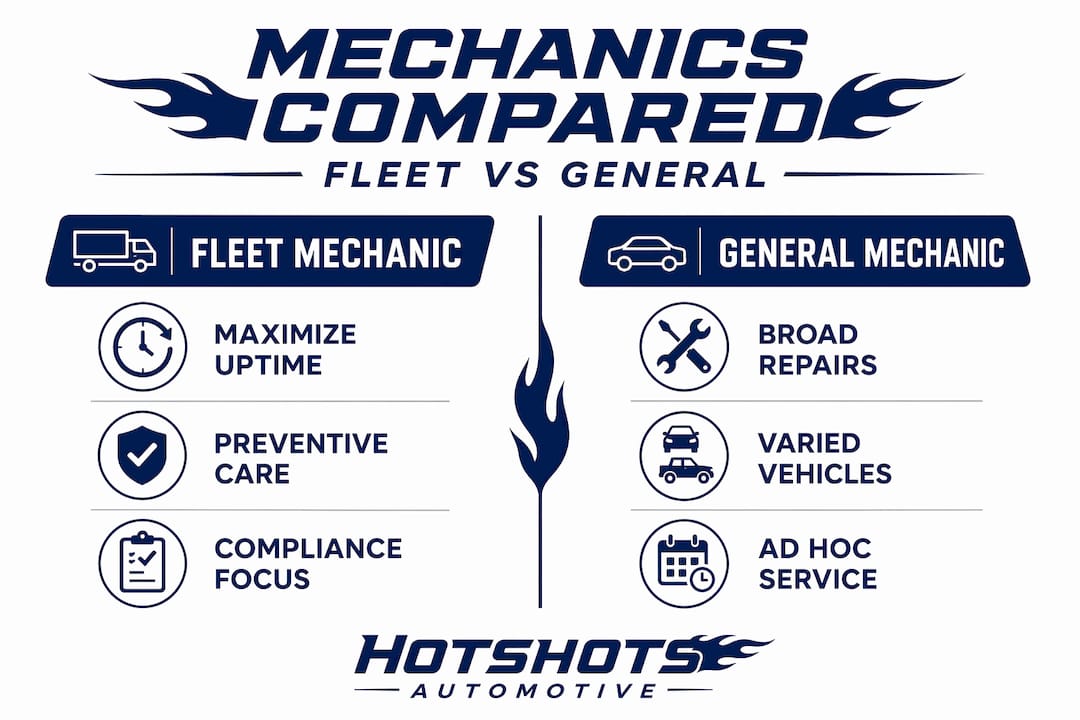
| Category | Fleet mechanic | General mechanic |
|---|---|---|
| Primary goal | Maximize uptime and minimize cost | Fix the current problem |
| Knowledge depth | Deep knowledge of specific fleet vehicles | Broad knowledge across many makes and models |
| Scheduling | Proactive, calendar and mileage-driven | Reactive, customer-initiated |
| Compliance support | Built into every inspection and service | Not a primary focus |
| Cost tracking | Fleet-wide cost analysis | Per-repair invoice |
| Communication | Regular reporting to fleet manager | Post-repair summary |
This is not a knock on general mechanics. They are essential for individual vehicle owners and for repairs that fall outside a fleet's normal scope. But for a business running five, ten, or twenty vehicles, the reactive model simply does not scale. Every hour a vehicle sits in a shop is an hour it is not generating revenue.
Here is what the depth versus breadth difference looks like in practice:
- A general mechanic can fix a brake problem on almost any vehicle. A fleet mechanic can tell you that three of your vans are showing early brake wear patterns and schedule them all before any of them fail.
- A general mechanic will replace a worn tire when you bring it in. A fleet mechanic will flag that your rear tires are wearing unevenly because of an alignment issue that has been developing for 4,000 miles.
- A general mechanic handles the repair in front of them. A fleet mechanic manages the total cost of ownership across your entire fleet.
For a closer look at how we handle common repair solutions for fleet vehicles, we break down the most frequent issues and how to get ahead of them.
Benefits to fleet managers and owners
By seeing these differences, you can appreciate the unique benefits dedicated fleet mechanics bring to your business. These are not abstract advantages. They show up in your operating costs, your driver safety record, and your compliance standing.

The value lies in preventing failures through maintenance, rapid diagnostics, and compliance-driven record keeping. Let's translate that into real business outcomes.
Reduced vehicle downtime is the most immediate benefit. When vehicles follow a preventive maintenance schedule, they spend less time in the shop for emergency repairs. A vehicle that gets regular oil changes, brake checks, and fluid services simply breaks down less. For a delivery company or service business in the Centennial and Parker area, every day a vehicle is off the road is a day of lost productivity.
Improved compliance and documentation protects your business from fines, failed inspections, and liability exposure. DOT-regulated vehicles require accurate logs. A dedicated fleet mechanic builds that documentation into every service visit, so you are never scrambling before an audit.
Lower total cost of ownership is the long-term payoff. Reactive repairs are almost always more expensive than preventive ones. Replacing a timing belt on schedule costs a fraction of rebuilding an engine after the belt snaps. Catching a coolant leak early costs far less than replacing an overheated engine.
Key benefits at a glance:
- Fewer emergency breakdowns and roadside incidents
- Consistent vehicle availability for your drivers and operations
- Accurate maintenance records for insurance, audits, and resale value
- Compliance with DOT and state vehicle inspection requirements
- Predictable maintenance costs instead of surprise repair bills
- Longer vehicle lifespan through disciplined preventive care
Statistic to keep in mind: Industry data consistently shows that preventive maintenance programs reduce overall fleet repair costs by 15 to 25 percent compared to purely reactive maintenance approaches. That is a significant margin for any business operating multiple vehicles.
Pro Tip: When evaluating a fleet mechanic or shop, ask specifically about their experience with your vehicle types. A shop that services diesel work trucks, gas-powered vans, and European imports with equal confidence brings far more value than one that specializes in only one category.
For a closer look at how we approach reliable fleet auto repair for local businesses, you will see exactly how we structure our services around your operational needs.
Why most fleet managers underestimate their mechanic's impact
Here is a perspective we have developed after nearly two decades of working with fleet operators in Centennial and Parker. Most managers think of their mechanic as a cost center. Something breaks, you pay to fix it. That mindset is costing you more than you realize.
The conventional wisdom is to hire whoever is available and cheapest. We understand the pressure. Fleet budgets are tight, and it feels like all mechanics do the same thing. But in smaller municipal or operations settings, even generalists must emphasize discipline in uptime and scheduling to keep operations running. The discipline is the differentiator, not just the technical skill.
A dedicated fleet mechanic who knows your vehicles, your routes, and your operational patterns is a strategic asset. They can tell you when a vehicle is approaching end-of-life before it becomes a liability. They can flag a pattern of brake wear that points to a driver behavior issue rather than a mechanical one. They can build a maintenance calendar that keeps your entire fleet available during your busiest seasons.
Local knowledge matters more than most managers admit. A mechanic who understands Colorado's altitude effects on engines, the wear patterns from Parker's road conditions, and the specific demands of Centennial's commercial corridors brings context that a national chain simply cannot replicate. We have seen that local expertise translate into faster diagnostics, smarter parts choices, and maintenance schedules that actually fit how your vehicles are used.
The record-keeping discipline that dedicated fleet mechanics bring is also chronically undervalued. Clean maintenance logs increase resale value, support warranty claims, and protect you legally if a vehicle is ever involved in an incident. That documentation is not just paperwork. It is a financial asset.
Our recommendation: stop treating your fleet mechanic as a vendor and start treating them as a partner. The return on that relationship compounds over time through fewer breakdowns, lower costs, and a fleet that runs the way your business needs it to. Our local fleet solutions are built on exactly that kind of long-term partnership.
Reliable fleet maintenance solutions in Centennial and Parker
The insights in this article point to one clear action: your fleet deserves a maintenance partner, not just a repair shop. At HotShots Automotive Repair, we have been serving fleet operators in Centennial and Parker since 2005, and we built our fleet program around everything covered here.
Our ASE-certified technicians bring the preventive mindset, detailed record-keeping, and compliance knowledge that dedicated fleet maintenance requires. Whether you run a handful of service vans or a larger commercial fleet, we tailor our approach to your vehicles and your schedule. Explore our full Centennial fleet repair services to see what we cover, review our fleet maintenance options to find the right fit for your operation, and check out our maintenance tips for managers to get started today. Call us or schedule online. We are ready to keep your fleet moving.
Frequently asked questions
What does a dedicated fleet mechanic do differently than a general mechanic?
A dedicated fleet mechanic specializes in preventive care, diagnostics, and compliance for one organization's fleet, rather than generic repairs for many customers. Fleet mechanics focus on preventive maintenance and documentation tailored to a single fleet, which is a fundamentally different approach than reactive, per-customer repair work.
How does a dedicated fleet mechanic help with regulatory compliance?
They maintain accurate logs and ensure vehicles meet DOT and state requirements, reducing the risk of fines or violations. Fleet mechanic roles explicitly emphasize regulatory compliance and maintenance records as core job functions, not optional extras.
Can a dedicated fleet mechanic save my business money?
Yes. By minimizing downtime and catching problems early through scheduled maintenance, you lower total repair costs and improve reliability. Preventive strategies and consistent documentation help control cost and improve uptime across the entire fleet.
Is a fleet mechanic suitable for small local fleets?
Absolutely. Smaller fleets benefit from tailored maintenance and disciplined scheduling just as much as larger ones. In small operations settings, even generalists need strong uptime discipline, which means the structured approach of a dedicated fleet mechanic adds real value regardless of fleet size.